

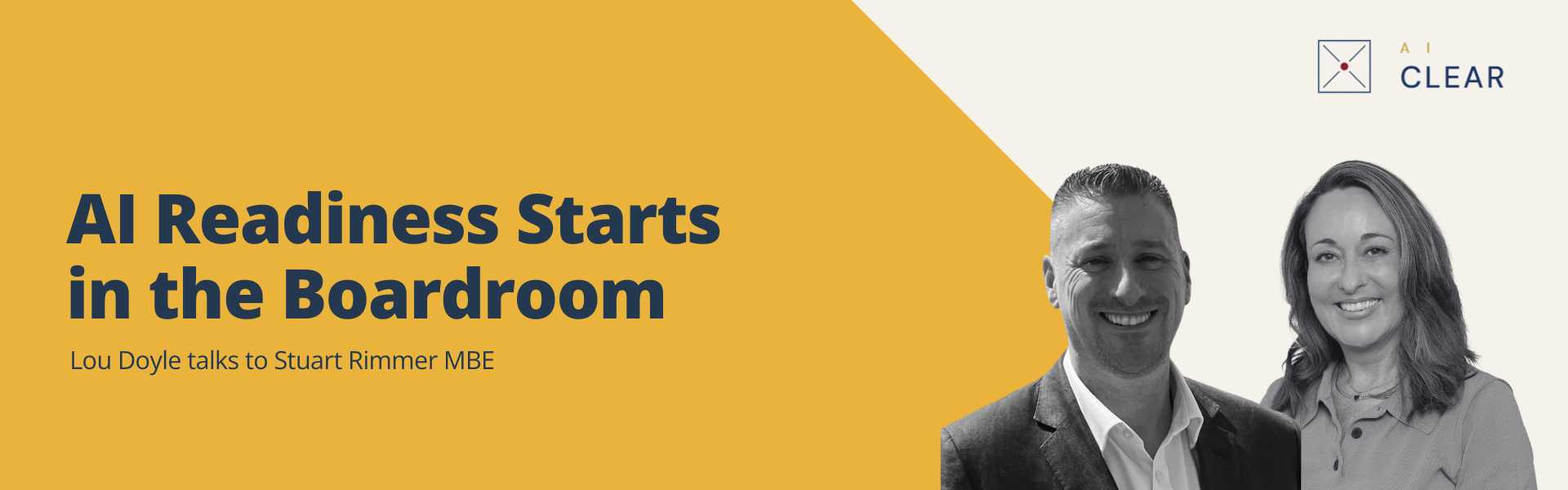
AI Readiness Starts in the Boardroom
Lou Doyle, Co Founder of SDN Mesma Group, in conversation with Stuart Rimmer MBE, founder of AI Clear Ltd.
In our work with boards, quality teams and compliance leads, AI is now part of daily practice. Assessing learner work, self-assessment drafts, learner feedback, progress reviews and funding evidence are just some examples of where AI is supporting users. However, we have found that in most organisations, the human check of output is informal or unclear. That check is the safeguard, and it is where we see the greatest risk for boards. Rethinking assurance has become a priority.
I spoke to Stuart Rimmer, founder of AI Clear and creator of CLEAR™, a board-level AI governance framework for further education and skills. Stuart built CLEAR™ to help boards evidence how they direct and answer for AI.
CLEAR™ draws on Stuart’s research, including the Education and Training Foundation’s AI Readiness Across FE and Skills report, which he co-authored. The framework itself is separate from the ETF report. We talked about the research, the risks boards face and how to get ahead of them this academic year.
What the research found
Lou: Stuart, the ETF report came out in July. What was the starting point?
Stuart: It began with a working paper called Ready or Not. I kept meeting capable, committed leaders who could talk through their AI pilots in real detail. When I asked who was accountable for those pilots, or how decisions were made, the answers were less settled. The subsequent ETF survey of 193 leaders, with Brendan Parker and Dr Vikki Smith, let us test that observation more widely.
Lou: In our client work we see AI use growing quickly, often ahead of any formal decision about it. Does the research reflect that?
Stuart: Very closely. Nine in ten leaders reported AI initiatives in the previous twelve months. Only 17 per cent said their organisation was well prepared, and 27 per cent had an AI governance framework. Jisc’s 2025 leadership survey shows the same pattern. Some 76 per cent of FE respondents use AI to prepare teaching, while 18 per cent feel sufficiently prepared on safety and 32 per cent on data protection. When use runs ahead of preparation, the risk sits with the board whether or not the board has seen it.
Lou: Why does that make it a governance question rather than a technology one?
Stuart: There are many examples so here is just one: AI now sits within safeguarding guidance and inspection. While Ofsted will not judge AI as a separate element, inspectors will look at whether a provider has made sensible decisions in the best interests of learners, and follow the consequences wherever AI touches data protection, safeguarding or bias. A board needs to be able to show how it decided. A board’s role is to oversee both the opportunities and risks AI presents, which are multifaceted in an education setting.
Keeping a human in the loop
Lou: Across our quality and compliance work, we often work with clients to put guardrails in place to avoid AI output going straight into use. At an operational level, this could be a self-assessment judgement, a progress review, a summary of learner feedback. Who should be checking it?
Stuart: That is exactly the question boards should be asking. The DfE is clear that a human stays in the loop, and that AI alone should never decide something that could harm a learner. In practice, the check often depends on one or two conscientious people. That holds until they are stretched or move on. Good governance designs the check in and assures itself that these are being carried out in practice.
Lou: There is a second risk we see, which is the tool itself. Generic AI tools are fluent, but they have no grounding in, for example, inspection frameworks, funding rules, or what good quality assurance looks like in our sector. That is why Mesma is built on the QA expertise our team has developed over many years. How do you see the difference?
Stuart: It is one of the first things a board should understand. General-purpose and specialised tools carry different risks, and a board should know which it is approving. A generic tool will give a plausible answer. Plausible is not the same as accurate. Weick’s research on sensemaking showed that people under pressure tend to accept a plausible account. The safeguard is a tool grounded in the right knowledge, used by a person qualified to judge what it produces.
Why CLEAR™
Lou: Where did CLEAR™ come from?
Stuart: I wanted to give boards something they could work with. The sector already has good guidance on what to do. What I wanted to add was a board-level view of what a corporation can evidence, written in the language of FE governance. CLEAR™ draws on the ETF findings, research on how organisations adopt new technology, and many conversations with leaders.
Lou: How does it work?
Stuart: It has five domains that follow a board’s governance journey: Context, Leadership, Execution, Accountability and Results. Each one is assessed against what the board can evidence rather than how confident people feel about it.
Lou: In board meetings we often see AI reported as progress, with very little on risk. Give us a taster of how CLEAR™ changes that conversation.
Stuart: Take Accountability. The question a board should be able to answer is: who answers when the system causes harm, and how would we know? A strong answer names a person, a route for learners to raise concerns and evidence of how each tool has been checked for bias and error. Many boards find that question harder than they expect, which is why it is a good place to start.
Lou: That rings true from our quality assurance work. Evidence of how a decision was made, and who checked it, tells you much more than a policy document on its own.
Working alongside the sector’s tools
Lou: There is a lot of AI support available to colleges already. Where does CLEAR™ fit?
Stuart: Alongside it. Jisc’s AI maturity toolkit is a really helpful way for institutions to see where they are on their AI journey. The DfE product safety standards, Ofsted’s approach and JCQ guidance all set clear expectations. CLEAR™ helps a board meet those from a position of its own. I have mapped it against those instruments so boards can see how the pieces connect.
Lou: If a Chair is reading this, what is a good first step to reduce their exposure?
Stuart: Put AI governance on the next board agenda. Then build a clear picture of every AI tool in use, including the ones nobody formally approved, and rate each by its risk to learners. Name a lead at board and executive level. Most leaders find the inventory more revealing than they expected. Neither step needs new money, and both give the board a firm footing for what follows.
Lou: What would you like from the sector?
Stuart: I want to test CLEAR™ properly with a group of pilot colleges, then publish it as a versioned, citable framework. I would rather it were tested by the sector than admired by it. Partners who want to help shape it are very welcome.
Let’s talk
If you would like to talk about your organisation’s AI risks and a practical next step, get in touch at hello@mesma.co.uk
To explore the CLEAR™ framework and discuss being part of the pilot, contact hello@aiclear.uk.
The full ETF report, AI Readiness Across FE and Skills (Parker, Rimmer and Smith, 2026), is free to read.
You can download Governing AI in FE and Skills: A Board Briefing below.
Mesma users will also find the document in Resources.
